Digital audio editing tools allow users to record and edit vocal tracks, manipulate virtual instruments and, produce music, podcasts and more (Future Music, 2011). Programs like GarageBand (2004) are by no means new, however new iterations such as GarageBand for iOS (2011) and tools such as the Chrome Music Lab (2016), are modernising the ways that digital audio can be edited and created, and incorporated into the classroom. The Chrome Music Lab is a suite of ‘experiments’ that is accessible online, which are designed to teach musical concepts in a hands-on way.
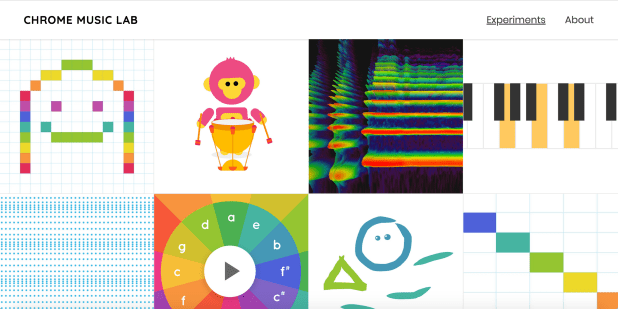
The first suggestion for the use of the Chrome Music Lab in the classroom is to use the Song Maker tool in providing younger students with the opportunity to become composers of their own music. The Creative Arts syllabus emphasises the way that organising and creating sound can allow for self-expression of emotion and imagination (Board of Studies, 2006). Song Maker has features such as a clean user interface and share functionality that facilitate the creative process of song composition. While easy to use for children from K-4, this may limit its use for older children and for more complex projects, as it does not have features such as voice recording and layering of instruments.
One alternative to offset the limitations of the Song Maker tool is Garageband for iOS which can be used to create more complex audio projects to complement other work. Some examples of project ideas that can be made with Garageband for iOS are soundtracks for a game or movie project, songs conveying information about a specific content point (e.g. Epic Rap Battles of History), podcasts and radio jingles. This iteration of GarageBand now available on tablets and phones is portable, simple to use on a touch screen and, has a larger selection of instruments and sound effects, all of which remove the parameters of music composition to foster creativity and expression (Thompson, 2012).
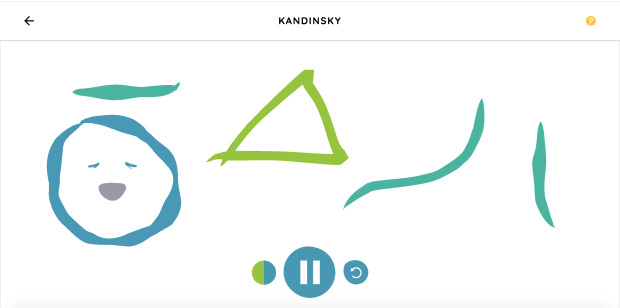
Additionally, the Chrome Music Lab has 13 tools that can all be used to enrich the learning of concepts from other KLAs in unique ways. For example, the Kandinsky tool allows students to draw shapes that make a corresponding sound, aligning principles of music with visual arts concepts like line and direction (Dinham, 2016). Other examples are the Spectrogram tool which visually represents sound frequencies and the Rhythm tool which can be used to teach fractions, by manipulating the beats per bar. The main pedagogical implication is that these tools are only limited in their capabilities, so it is recommended to use them in the preparatory stages of creative learning as they don’t provide much opportunity for divergent thinking (Wheeler, Waite & Bromfield, 2002).
References
Board of Studies. (2006). Creative Arts K-6 Syllabus. Sydney.
Dinham, J. (2016). Delivering Authentic Arts Education (3rd ed., pp. 246-281). Melbourne: Cengage Learning Australia.
Future Music. (2011). A brief history of GarageBand. Retrieved from https://www.musicradar.com/tuition/tech/a-brief-history-of-garageband-400471
Thompson, D. (2012). Music Technology and Musical Creativity. General Music Today, 25(3), 54-57. doi: 10.1177/1048371311434639
Wheeler, S., Waite, S., & Bromfield, C. (2002). Promoting creative thinking through the use of ICT. Journal Of Computer Assisted Learning, 18(3), 367-378. doi: 10.1046/j.0266-4909.2002.00247.x
All screenshots taken from the Chrome Music Lab. All videos are my own work.


Music can definitely have a profound impact on students (and people) of any age! I really enjoyed reading about the use of the Chrome Music Lab on assisting students develop their self-expression and emotion. Providing a safe environment for students to express their emotions is so important to creating a positive and secure classroom environment. I am curious as to how this could be used in developing student’s critical thinking alongside creative thinking. How do you think that this emerging technology could be used for older students as well? I am going into Secondary Science teaching so reading about your emerging technology has gotten me thinking about how this could be used across many different disciplines, not just in a primary or in a music-specific setting. Are you aware of some other benefits to students, apart from developing creative thinking and expressing emotion? I am interested in how this technology may influence student motivation and what research has been done to prove its effectiveness in the classroom (with evidence), regarding increasing a student’s creative thinking.
Thank you for your insight, and for providing me with new knowledge. Your post has definitely got me thinking about how I may use this in my Science classroom to maximise student learning 🙂
Kind Regards, Alexandra
LikeLike
Hi Alexandra, thanks for your comment – you raise a lot of interesting points! As a primary education student, I think I did write my critique from a very primary-centric viewpoint but I definitely think it has potential for use for older students and in science education. The main problem is that most of the ‘experiments’ in the suite are quite close-ended (apart from some like the ‘Song Maker’ tool), so for example in the ‘Oscillators’ tool, you click and drag and then the tool will make different sounds and show different frequencies. This means that there aren’t many opportunities for critical or divergent thinking. However, as I mentioned in my response, the open-ended tools can be used creatively within music education, and the other tools can be used in the preparatory stages of learning, to scaffold or introduce a concept as sort of a springboard for fostering creativity. For secondary science students, the ‘Spectrogram’, ‘Sound Waves’, ‘Harmonics’ and ‘Oscillators’ tools can be used to introduce concepts such as sound frequencies. Additionally, because the Chrome Music Lab is still quite new, I couldn’t find many studies about its direct impact on student learning and motivation, however this study (http://www.ijea.org/v15n5/) expands on the relationship between music and neuroscience, citing benefits such as increased visual memory, emotion processing, phonological awareness and executive function. I, too, am interested in whether the learning carried out by the Chrome Music Lab can provide the same type of benefits to students as face to face music education, so time will tell!
LikeLiked by 1 person