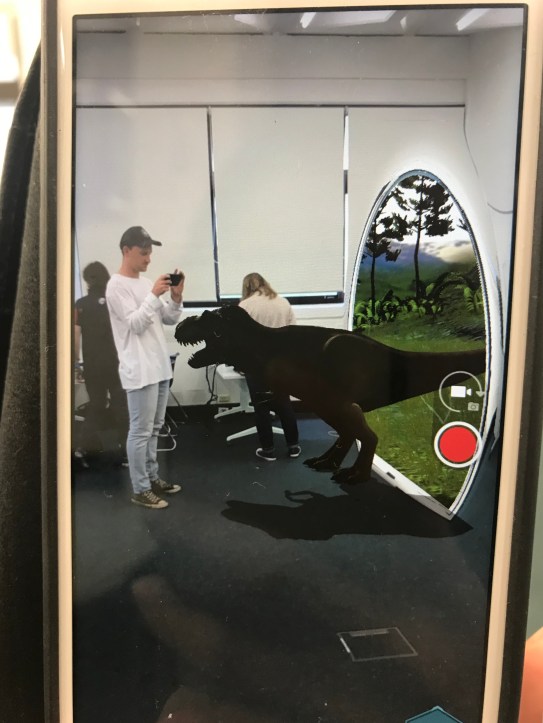
Augmented Reality (AR) is defined as the overlaying of media such as images, text, and video over a trigger image, to enhance the existing environment (Wu, Lee, Chang & Liang, 2013). As it currently stands, AR is used by educators to teach in creative ways as well as incorporated to foster creativity with students as users, and both approaches have their places in the classroom (O’Shea, 2011).
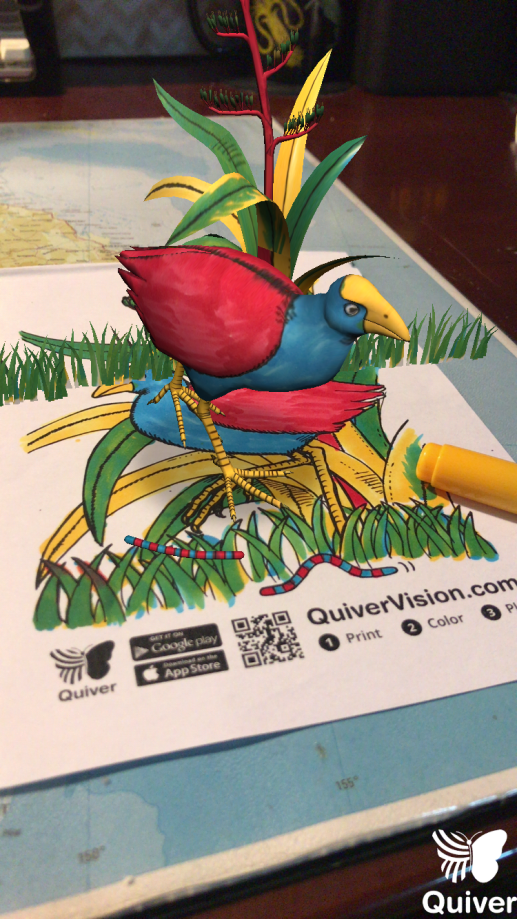
The first approach is teacher-as-designer, while not as directly promoting of creativity as student-as-designer, still has many educational benefits and uses. One way that educators can use AR to teach creatively, is just through the viewing of previously static 2D mediums in a now dynamic way (Kesim & Ozarslan, 2012). For example, apps like Quiver which provides interactive, printable colouring pages or books like this that represent obscure concepts such as the inside of the human body. These tools may be used as a starting point for further learning with AR.
Educators may also design learning experiences centred around AR that go beyond just play. Location-based AR apps like FreshAiR could be incorporated into a class excursion where students use a mobile device to point at trigger locations to view information and prompts for activities, for example measuring the water quality at a pond (Kamarainen et al., 2013). The obvious limitation is that these tools don’t foster creativity within students directly, however still promote an interactive classroom, and allow students to have authentic learning experiences that align with the immersive, context-based principles of the situated learning theory (Dunleavy, Dede & Mitchell, 2009).
The other approach is student-as-designer, in which students have the opportunity to use platforms such as ZapWorks to design their own AR experiences. Allowing students to be designers has a wide range of advantages, including fostering higher order thinking skills such as evaluating and creating, encourages deeper understanding of intended concepts and has links to higher motivation and engagement in learning (Bower, Howe, McCredie, Robinson & Grover, 2014). AR technology can be woven into lessons across the curriculum in learning areas like Maths, Science and HSIE, however there are some potential consequences such as cognitive overload in having to learn how to design in AR as well as engaging with the content – all of which can be alleviated with appropriate planning and management (Dunleavy, Dede & Mitchell, 2009).
Reference List
Bower, M., Howe, C., McCredie, N., Robinson, A., & Grover, D. (2014). Augmented Reality in education – cases, places and potentials. Educational Media International, 51(1), 1-15.
Dunleavy, M., Dede, C., & Mitchell, R. (2009). Affordances and Limitations of Immersive Participatory Augmented Reality Simulations for Teaching and Learning. Journal of Science Education and Technology, 18(1), 7-22.
Kamarainen, A., Metcalf, S., Grotzer, T., Browne, A., Mazzuca, D., Tutwiler, M., & Dede, C. (2013). EcoMOBILE: Integrating augmented reality and probeware with environmental education field trips. Computers & Education, 68, 545-556.
Kesim, M., & Ozarslan, Y. (2012). Augmented Reality in Education: Current Technologies and the Potential for Education. Procedia – Social And Behavioral Sciences, 47, 297-302.
O’Shea, P. (2011). Augmented Reality in Education. International Journal Of Gaming And Computer-Mediated Simulations, 3(1), 91-93.
Wu, H., Lee, S., Chang, H., & Liang, J. (2013). Current status, opportunities and challenges of augmented reality in education. Computers & Education, 62, 41-49.
 All Hands on Tech