Design thinking is the pedagogical approach of encouraging and facilitating students as they carry out the process of design from conceptualisation to realisation and production (IDEO, 2012). One emerging technology that provides students with the opportunity to be designers is the 3D modelling software SketchUp and its capacity for 3D printing.
Design often occurs in response to a problem or need, and this process is outlined in the Science and Technology syllabus outcome ST3-3DP-T, which requires Stage 3 students to define problems, and design, modify and follow algorithms to develop solutions (NSW Education Standards Authority, 2017). The Discovery and Interpretation phases of the IDEO design process encourage students to research and plan their solutions to real-world problems (IDEO, 2012). However, for an authentically meaningful learning experience, educators need to set a design problem within set constraints and provide guidance, reflecting the processes of real designers and architects (Brown, 2012).
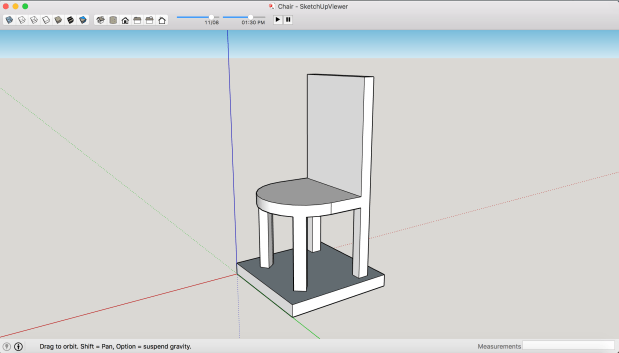
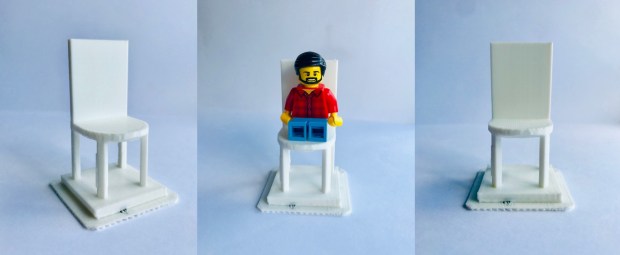
The next two phases of the IDEO design thinking process, Ideation and Experimentation, require students to engage in the formation of ideas and the generation of prototypes such as storyboards, diagrams and models. (IDEO, 2012). SketchUp is a computer-aided design (CAD) program that allows users to easily create 3D models, beyond pen-and-paper drawings because of tools such as the Tape Measure, Push/Pull and Offset, as well as view tools such as Orbit and Pan (Laiserin, 2001). SketchUp has potential for designing new products, buildings or in this example, a chair made to scale to fit a LEGO minifigure with the objective of it being 3D printed.
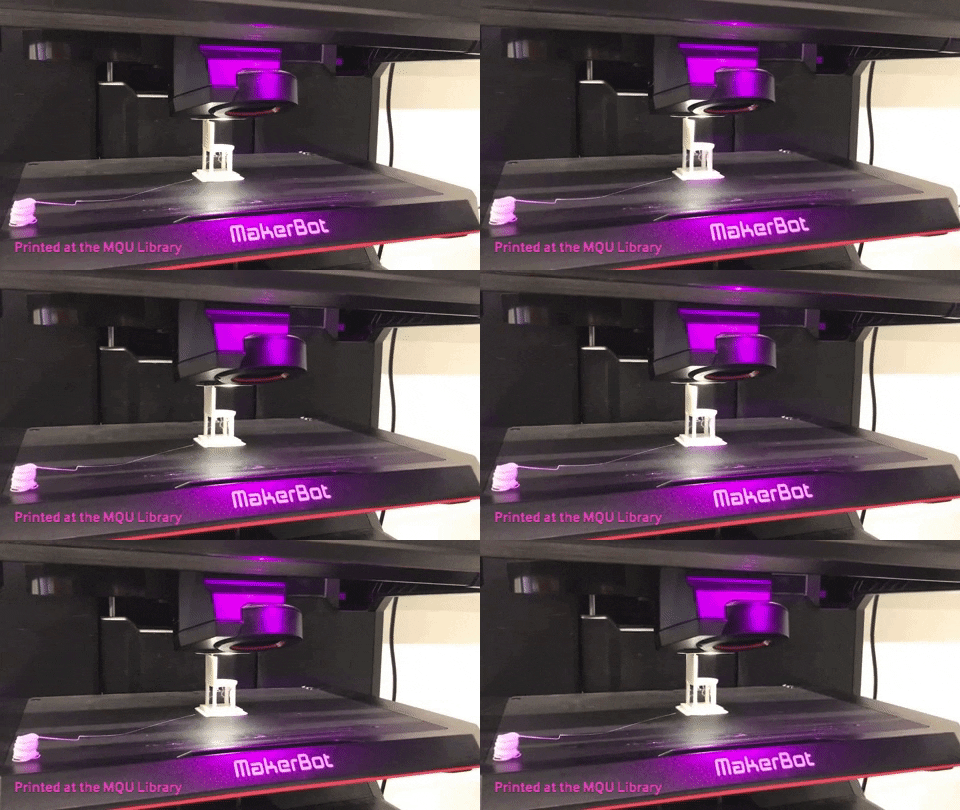
The final phase of the design thinking process is Evolution, in which the students evaluate their products and re-work their designs, if necessary (IDEO, 2012). While the hands-on design and implementation are important processes, reflecting on design strengths and weaknesses are key to the development of critical thinking and confidence (Grammenos & Antona, 2018). Ultimately, design thinking using tools like Sketchup and 3D printing requires students to be empathetic, collaborative and experimental – traits valued in the modern workforce and in life (Brown, 2008).
Reference List
Brown, T. (2008). Design thinking. Harvard Business Review, 86(6), 84-92.
IDEO (2012). Design thinking for educators (2nd ed). Available at: http://designthinkingforeducators.com/
Grammenos, D., & Antona, M. (2018). Future designers: Introducing creativity, design thinking & design to children. International Journal Of Child-Computer Interaction, 16, 16-24.
NSW Education Standards Authority. (2017). Science and technology K-6 syllabus. Retrieved from: https://educationstandards.nsw.edu.au/wps/portal/nesa/k-10/learning-areas/science/science-and-technology-k-6-new-syllabus


Hi Tyra, thanks for the read. I appreciate how you’ve written this post through the IDEO lens, which works well for breaking down design-based thinking. I agree that Sketchup is one of the better CAD programs and you’ve illustrated your point clearly, even referencing specific tools. I would however like to see exactly how this could be used in the classroom and question how 3D printing requires students to be empathetic.
Cheers,
Alex.
LikeLike